Germany’s solar market has reached a new level of maturity, marked not only by sustained capacity growth but by a fundamental shift in how renewable energy is generated, distributed, and consumed. As the country moves beyond a purely expansion-driven phase, the rapid growth of the commercial and industrial (C&I) segment is already reshaping market structures, while new consumption and coordination models – particularly emerging energy-sharing frameworks – are expected to play a more significant role in the future. Together, these developments signal a transition toward a more integrated, flexible, and decentralised energy system.
Bonn, April 22, 2026: Germany added more than 16.4 GWdc of new solar capacity in 2025[1], bringing total installed PV capacity above 117.0 GWdc and covering around 15% of national electricity demand. While this underscores the continued momentum of the market, it also reflects a fundamental shift: the challenge is no longer capacity expansion alone, but how this capacity is integrated, utilised, and optimised within the energy system – a trend increasingly observed as global solar markets move from volume-led growth to system-centric deployment strategies, where integrated solutions such as PV‑plus‑storage are essential for project viability[2].
This transition is also visible in the structure of newly installed capacity. While residential systems remain important, a growing share comes from C&I applications and larger distributed assets. Together, these developments indicate that Germany’s solar market is entering a new phase defined by more system integration, flexibility, and coordination across multiple actors.
At the core of this transition lies a structural limitation of the traditional model. Historically, solar PV in Germany has been largely based on individual self-consumption, where generation and consumption are tied to a single asset owner. While effective in earlier stages of market development, this model increasingly limits system efficiency in a high-renewables environment, where generation and demand are not always aligned.
A key element of the ongoing transformation is the gradual emergence of shared and coordinated consumption models. In this context, energy-sharing frameworks, as defined under the European Clean Energy Package and increasingly reflected in national discussions, are expected to enable the allocation of locally generated renewable electricity across multiple consumers within defined communities or grid areas. These models go beyond building-level applications and point toward broader, more flexible forms of local energy utilisation.
In Germany, the concept commonly referred to as 'Tenant electricity' (Mieterstrom in German)[3] has so far played only a limited role in the overall market and has primarily been confined to specific use cases in multi-family housing. Rather than representing a dominant driver today, it can be understood as an early and relatively narrow implementation of localised consumption concepts. With the introduction of regulatory provisions for energy sharing under the Energiewirtschaftsgesetz (§ 42c EnWG)[4], effective from June 2026, locally generated renewable electricity is expected to be shared more broadly across multiple participants, enabling more scalable and system-oriented applications beyond individual buildings, although its market impact will need to be observed over time. By contrast, the C&I segment continues to outpace other segments in driving market growth. In 2025, C&I installations accounted for approximately 5.6 GWdc, representing around one-third of total new PV capacity in Germany[5].
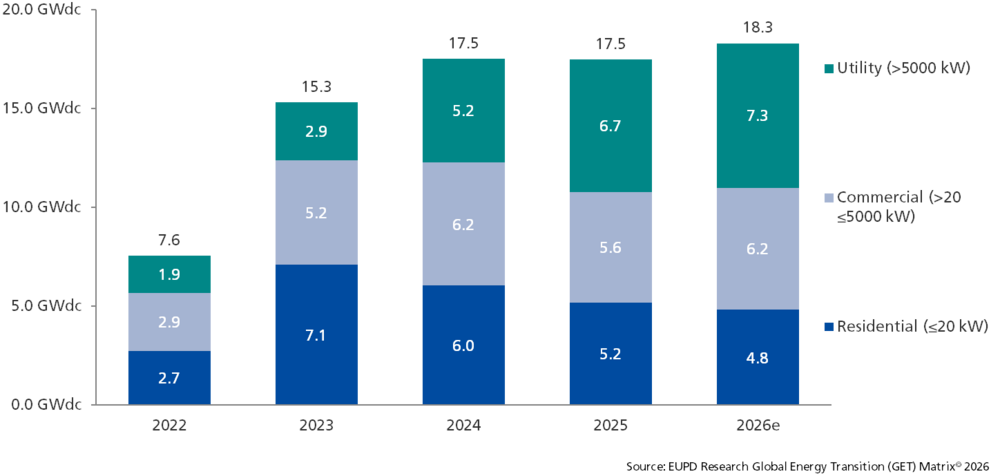
This growth is driven by rising electricity price volatility, increasing decarbonisation pressure, and the need for long-term cost predictability, as businesses and industrial consumers invest in on-site generation to hedge against market risks and secure more stable energy costs.
Unlike earlier phases of the market, C&I projects are increasingly embedded in broader energy strategies that combine solar generation with battery storage, load management, smart metering, and digital optimisation. As a result, these installations are evolving from standalone generation assets into integrated energy systems capable of providing flexibility and participating in emerging energy markets.
The interaction between C&I assets and emerging energy-sharing concepts is particularly relevant for the future structure of the energy system. Industrial sites, business parks, and mixed-use developments provide suitable environments for coordinating generation and consumption across multiple actors. In such settings, locally generated electricity can be used more efficiently through aggregation and smart allocation mechanisms, paving the way for more sophisticated local energy ecosystems.
Within this evolving landscape, energy suppliers are expected to play an increasingly central role. Moving beyond their traditional role of retail intermediary between energy generators and end-users, they are gradually positioned to become platform operators of local energy systems, facilitating the coordination of generation, consumption, storage, and grid services. By enabling infrastructure, managing data, and orchestrating energy flows, energy suppliers can act as key enablers of regional energy-sharing ecosystems that connect commercial and industrial assets, distributed PV, storage systems, and end consumers.
Commercial PV and storage solutions are therefore increasingly developing into the infrastructural foundation of such regional energy-sharing models. In this context, energy suppliers have the opportunity to expand their strategic role from energy providers to system integrators and platform operators, supporting the coordination of decentralised assets while maintaining grid stability and enabling new value streams. This reflects a broader structural shift within the German energy system. The market is gradually moving away from isolated, subsidy-driven installations toward market-based, system-integrated configurations that emphasise flexibility, coordination, and local optimisation. Digital infrastructure, including smart meters and energy management platforms, will be critical in enabling these developments at scale. Policy simplifications and evolving regulatory frameworks further support this transition, while new evaluation approaches increasingly prioritise system value rather than installed capacity alone.
Looking ahead, flexibility is set to become the central value driver of the energy transition. As renewable penetration continues to increase, the ability to balance generation and demand locally and in real time will define the efficiency and resilience of the system. In this context, the expected rollout of broader energy-sharing frameworks and the expansion of the C&I segment, will play a central role in shaping a more decentralised, flexible, and integrated energy system in Germany. The continued recognition of innovation through initiatives such as the Energy Transition Award (Energiewende Award in German)– jointly initiated by EUPD Research and The smarter E Europe – underscores the growing importance of leadership, best practices, and measurable progress in accelerating this transformation.
Energiewende Award (Energy Transition Award) for Energy Supplier
On June 25, 2026, the 10th Energiewende Award ceremony will take place at The smarter E Forum, Hall C5, Booth C5.550 at The smarter E Europe in Munich, Europe’s largest alliance of exhibitions for the energy industry. It aims to recognise energy providers that go beyond compliance by offering forward‑looking services that empower consumers and support the broader energy transition. In addition to a detailed analysis of multiple criteria across relevant future domains in the DACH region, the award highlights utilities from Denmark, France, Italy, the Netherlands, Norway, Spain, and the United Kingdom, reflecting a broader commitment to cross-European innovation and sustainability
A detailed programme of the Energy Transition Award ceremony can be found below.
12:00 PM Opening of the Energy Transition Award for Energy Suppliers
12:05 PM Energy Suppliers - Europe
Panel Discussion and Award Ceremony | DK, ES, and UK
12:40 PM Energy Suppliers - DACH Region
Panel Discussion and Award Ceremony | Categories:
Electricity, Heat, Energy Efficiency, Mobility, and Energy Transition
01:40 PM Closing Remarks
02:00 - 03:00 PM Photo Session and Get-Together in the VIP Utility Lounge (invite only)
Further information on the Energiewende Award can be found at https://www.energiewende-award.de/en/home/. If you have any questions, please contact Saif Islam (+49 (0) 228 504 36-20, islam[at]energiewende-award.de), Giulia Lohmar (+49 (0) 228 50435-34, g.lohmar[at]eupd-research.com) or Kim Wiersberg (+49 (0) 228 50435-55, k.wiersberg[at]eupd-research.com).
Press Contacts:
Julia Lünnemann
International Communication and Event Manager
EUPD Group
j.luennemann[at]eupd-research.com
Katja Werner
Corporate Communications Manager
EUPD Group
k.werner[at]eupd-research.com
About the EUPD Group
The EUPD Group is an internationally active market research and certification company specialising in the area of sustainability. Since its foundation in 2000, the company has provided primary data-driven analysis, certification and publication services to support companies in developing and implementing successful business strategies. The company’s areas of focus include ESG, renewable energy and corporate health as well as social sustainability. The EUPD Group aims to enhance market transparency, provide clear orientation and support companies in maintaining and strengthening their competitiveness in a rapidly evolving global environment.
https://eupd-group.com/
[1] https://www.bundesnetzagentur.de/DE/Fachthemen/ElektrizitaetundGas/ErneuerbareEnergien/EE-Statistik/DL/EEStatistikMaStR.pdf?__blob=publicationFile&v=48
[2] https://www.pv-magazine.com/2026/01/12/global-solar-enters-period-of-adjustment-as-market-conditions-redefine-rules-of-competition/
[3]https://www.bundeswirtschaftsministerium.de/Redaktion/EN/Artikel/Energy/landlord-to-tenant-electricity-supply.html
[4] https://www.enbw.com/blog/energiewende/solarenergie/energy-sharing-solarstrom-miteinander-teilen
[5] https://eupd-group.com/product/global-energy-transition-get-matrix/