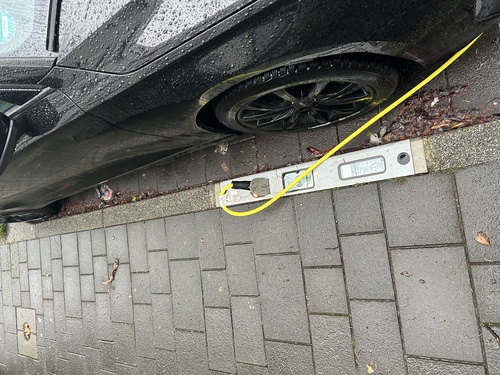
The expansion of publicly accessible charging infrastructure is a crucial factor for the successful electrification of transport. In densely populated cities with narrow sidewalks and limited parking space, traditional charging stations can reach their limits in terms of planning, design, and user convenience. Putting charging cables across the sidewalk or even hanging them out of windows is not a solution.
Alternative approaches such as upgraded lampposts are already known, and curbside charging is another innovative approach. The charging electronics are integrated directly into the curb, allowing charging points to be installed in a space-saving and discreet manner along parking lanes. At the same time, this approach raises new questions and makes clear that, in addition to opportunities, there are also challenges and hurdles in terms of planning, operation, and acceptance.
A concrete example of the practicality of the charging curb approach is provided by the joint trial conducted by Rheinmetall, the municipality of Cologne, and the infrastructure operator TankE. Between April 2024 and March 2025, four charging curbs were tested on public roads in the Lindenthal district. The trial was accompanied by a case study, which came to the following conclusions:
With the completion of the pilot phase, the four charging points were transferred to regular operation, and the charging curbs are now part of the public charging infrastructure. In addition to their technical robustness, the results show that charging curbs prove themselves in demanding everyday use and can be a useful addition to traditional public charging points.
First serial installations in public space in Düsseldorf
Another exciting example comes from Düsseldorf: in the summer of 2025, Stadtwerke Düsseldorf, in collaboration with Rheinmetall, put the first series-produced charging curbs into operation along Derendorfer Allee. Prior to public installation, the prototypes were tested on the Stadtwerke Düsseldorf premises for more than a year. These tests formed the basis for the charging curbs now being ready for serial production.
The Düsseldorf project shows that curbside charging not only works in pilot status, but can also be mass-produced, tested, and integrated into regular public operation. The charging curbs are marked with floor markings and signs, which are also found at regular charging stations. There is no special indication on the curb, which may lead to confusion.
A look abroad shows that concepts similar to curbside charging are also being tested internationally. In London, lamppost chargers are being installed, compact chargers directly on street lamps that supply parked electric cars during normal street parking. In New York and San Francisco, pilot projects are testing charging points that are integrated directly into the roadway in inner-city parking bays and are designed for short charging times. These approaches make use of existing road space, minimize space requirements, and provide valuable insights for the design of urban charging infrastructure without relying on traditional freestanding charging stations.
The practical results from Cologne and Düsseldorf have been positive overall. However, key aspects need to be clarified on a case-by-case basis before a broad rollout can take place. These include the question of the extent to which design, integration into the urban landscape, and an encapsulated and replaceable system offer real advantages. It is also necessary to examine whether additional costs may arise from the replacement of existing curbs and adjustments to drainage, cable, and other civil engineering infrastructure. Depending on the individual case, these issues are also relevant for conventional AC charging stations.
Regardless of this, it is strongly recommended that the visibility of the charging infrastructure be specifically adapted, particularly through clear signage. While discreet design integration may be convincing from an urban planning perspective, it can sometimes pose a challenge from the user's point of view. Without additional markings, signage, or digital indicators, charging curbs are much more difficult to recognize than traditional charging stations, which are immediately perceived as charging infrastructure by e-motorists. This increases dependence on navigation and charging apps, which can be an additional hurdle, especially for spontaneous or non-local users.
Overall, charging curbs are an innovative and specialized tool in the municipal charging infrastructure planning toolbox, and their further market development should be closely monitored.