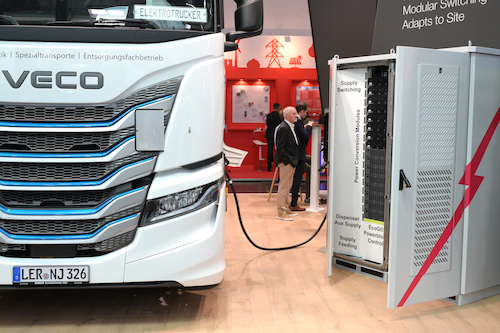
Europe is driving forward the development of megawatt charging infrastructure for heavy electric trucks. In one of the latest large-scale projects, E.ON, Voltix, and GreenWay have received a commitment of €70.3 million in EU funding to build a cross-border network with around 330 megawatts chargers along major transport routes in Europe.
The locations are spread across 55 sites in nine European countries and are scheduled to be completed by fall 2028. Each charging point will offer at least 1 MW of charging power and will be accessible to the public around the clock.
At the same time, the “HoLa” project in Germany is demonstrating how megawatt charging can work. In September 2025, the first publicly accessible megawatt charging point for heavy electric trucks went into operation on the A2 highway near Bielefeld. There, vehicles can achieve charging capacities of up to 1.2 MW, enabling them to recharge enough energy for hundreds of kilometers of range in 30 to 45 minutes. Research, industry, and politics worked together to implement this project, which is an important signal for the practical feasibility of the technology.
Megawatt charging as a hub system, depot charging as a basis
Megawatt chargers are intended for long-distance electric truck transport at major hubs along international corridors. The charging capacity of over 1 MW is designed to make electric heavy-duty transport with short stops between destinations feasible. At the same time, megawatt charging provides a safety net for electric truck drivers in case of emergencies and makes it easier for drivers to switch to electric vehicles.
According to Eurostat, only about 7-10% of goods are transported over distances of more than 500 km. A significant proportion of everyday truck movements involve shorter distances and depot cycles. These will continue to be served predominantly by depot charging systems or conventional CCS fast charging points (up to 350 kW). A study by the ICCT predicts that several thousand megawatts of charging points will be needed in Europe by 2030 for long-distance travel, but overnight and depot charging infrastructure will remain the dominant form of charging for battery trucks, as the majority (approx. 85%) of goods are transported less than 300 km.
This division of demand creates a flexible system that effectively supports both long-distance transport and regional logistics.
Megawatt charging is not purely a European topic. In China, Huawei opened a comprehensive charging park for heavy electric trucks in 2025. The park has around 18 megawatts chargers with up to 1.44 MW charging capacity and offers a total of up to 100 MW of power. This project shows how megawatt charging works on a large scale.
The market is also growing in North America. Initiatives such as the NEVI program and providers such as Kempower are testing the first megawatt charging infrastructures for trucks, particularly at logistics and fleet locations. Depot-based charging and CCS charging stations still dominate, but demand for high-performance public megawatt chargers is increasing in the wake of long-distance trials and pilot projects, especially in large countries with high transit volumes.
The expansion of megawatt charging infrastructure in Europe is taking shape and positioning the continent as a pioneer in electric heavy-duty logistics. Megawatt chargers on transport axes are an essential element for long-distance transport, while depot charging and CCS fast charging remain central to many everyday and regional movements.
Pilot and commercial megawatt charging projects are emerging globally, especially in China and North America, underscoring the growing relevance of this technology worldwide. The next few years will be crucial for establishing technical standards, economic models, and operator structures that will enable the sustainable and widespread use of this high-performance charging infrastructure.
It is therefore important that a future-oriented economy actively embraces this trend and recognizes megawatt chargers and depot charging as strategic drivers of future mobility. The expansion of planning, grid connection, construction, operation, and digital control will create new industrial value chains, as well as additional skilled jobs in energy, infrastructure, software, and logistics. At the same time, existing jobs in transportation, automotive engineering, and the supply industry could be stabilized by further developing existing expertise and integrating it into new business models.