European heavy-duty electric vehicles are fit for the future. A network of so-called megawatt chargers is emerging along key transportation routes, where large, heavy e-trucks can charge their batteries in record time. This gives a major boost to the shift towards sustainable mobility in heavy-duty transportation, and it is made possible by a pioneering technology: the megawatt charging system (MCS). There are plans for 330 MCS with one megawatt of charging power each to be installed across the European Union (EU) by the fall of 2028. Each of the 55 locations in Germany, Austria, Denmark, Spain, France, the Netherlands, Sweden, Poland and Hungarywill be open to the public 24/7. The charging network is being built by a consortium made up of E.ON, Voltix and GreenWay, supported by EU funding exceeding 70 million euros. At Power2Drive Europe on June 23–25, leading suppliers and developers will present their high power chargers, megawatt charging systems and new plug-in connectors. The international exhibition for charging infrastructure and e-mobility takes place at Messe München as part of The smarter E Europe, Europe’s largest alliance of exhibitions for the energy industry. Around 2,800 exhibitors and more than 100,000 visitors are expected to attend.
The MCS is an internationally standardized charging system which constitutes an important step towards climate-friendly long-distance travel, helping e-trucks to become attractive, flexible and economical options. They can compete with diesel vehicles in terms of range, charging time and cost efficiency. “MCS solutions are a necessary development for heavy-duty vehicles and provide a fallback system that can drive the widespread transition. It improves charging safety for users. It is also helpful as a contingency solution, like during breaks, nightly resting times or in the depot when fast charging is not enough,” says Joel Wenske, project leader of Power2Drive Europe. “Europe is creating a reliable foundation to successfully ramp up future-oriented mobility for the transportation sector.”
This could give a major boost to the industry’s electrification. To avoid hefty fines, truck manufacturers in the EU need to reduce their carbon emissions by 45 percent by 2030. This goal can only be achieved through a significant rise in the sales of electric trucks, which in turn depends on a reliable, fast charging infrastructure. A study by the International Council of Clean Transportation (ICCT) predicts that by 2030, several thousand megawatt charging points will be required in Europe. Thanks to this expansion, Europe is now positioning itself as a trailblazer in electric heavy-duty logistics. Megawatt chargers supplement depot charging and Combined Charging System (CCS) fast charging points. CCS is a fast charging standard that is already used by many battery electric trucks. Depot charging and CCS will remain the dominant charging forms in the future as, according to data from Eurostat, only seven to ten percent of goods are transported more than 500 kilometers, with most travelling less than 300 kilometers. For shorter, everyday journeys or regional transportation, charging e-trucks overnight through the depot charging system or CCS charging station (up to 350 kilowatts) is sufficient.
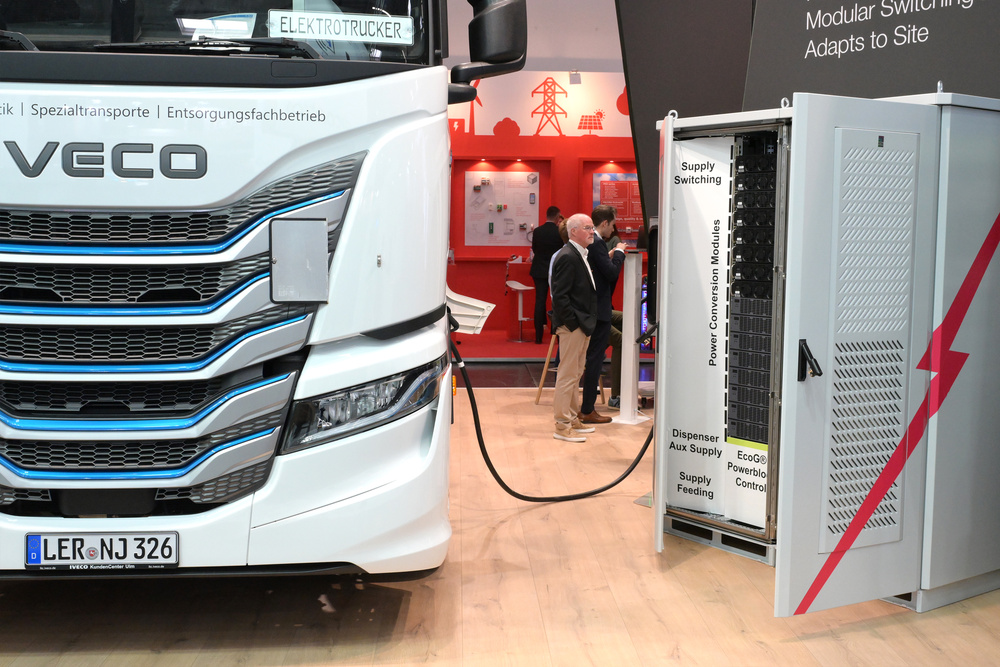
In Germany, project HoLa is testing the new MCS technology under real-life conditions, while also creating the foundation for an extensive ramp-up. The first official megawatt charging point for heavy e-trucks came into operation at the Lipperland Süd service station on the A2 highway on September 29, 2025. Drivers can recharge their vehicles with up to 1.2 megawatts during a short break or a legally required resting period. Within just 30 to 45 minutes, this gives the battery enough charge to travel several hundred kilometers. Research, innovation and policy work together in the HoLa project. Four locations are planned in Germany. The Federal Ministry of Transport and Digital Infrastructure is supporting the project with twelve million euros.
In December 2025, the European Commission gave the green light for the German government to fund the construction of high-speed truck charging stations (CCS and MCS charging points) in highway lay-bys, with up to 1.6 billion euros available. Up to 725 CCS charging points and 685 MCS charging points are planned.
Europe is not the only region promoting megawatt charging, though. In China, Huawei opened a large charging park for heavy e-trucks in 2025. The park has around 18charging points with up to 1.44 megawatts of charging power each, providing a combined 100 megawatts. This shows that the Asian market is focusing on high power classes. In North America, the demand for public high-performance megawatt chargers is growing too. Initial tests are being performed at logistics and fleet locations.
These developments in Europe, China and North America reflect the importance of the technology today. Over the next few years, we will see which technical standards, economic models and operational structures for expanding ultrafast charging infrastructure come out on top. We now need to capitalize on this trend and recognize it as a strategic driver for the mobility transition. Power2Drive Europe positions itself as a trendsetter and showcases the most important players. Leading industry players will be sharing insights into their modern high-power charging systems in hall C6. On June 22, the afternoon of the Power2Drive Europe Conference will be all about grid integration. Megawatt charging stations can overwhelm local connection lines – but intelligent control can help to stabilize the grid.
Planning, grid connection, construction, operation and digital control can lead to the rise of new industrial value chains and the creation of new jobs in energy, infrastructure, software and logistics. Existing jobs can stay safe as know-how improves and fits into new business models.
In the future, MCS will play an important role in areas where large amounts of energy are needed fast. For many traditional logistics companies, charging at the depot is still the more appealing optionfor delivery vehicles and trucks that regularly return to the site. Intelligent charge management can cut energy and operating costs considerably, so expanding charging infrastructure at logistics depots is key.