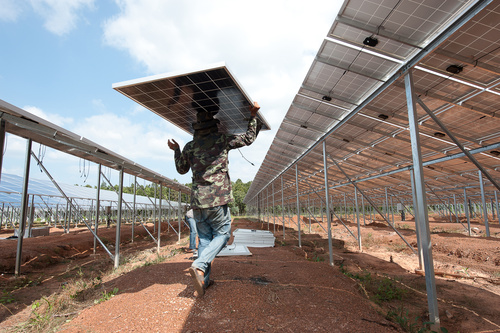
Globally, Africa is the second biggest potential region with renewable energy sources. Although solar energy is already the second-biggest renewable source with 15.7 gigawatts (GW) of cumulative capacity installed, it only accounts for 3 percent of the continent’s electricity generation. Therefore, there is huge untapped solar potential in Africa.
Unlocking this potential is crucial for decarbonizing the continent's energy sector, achieving universal access to sustainable energy by 2030 (SDG No. 7), and promoting cheap energy supply alongside the development of a vibrant new regional industry.
In 2024, the African market grew by 2.4 GW, with South Africa leading the rankings at 1,3 GW (46%), followed by Egypt at 700 megawatts (MW) (29%), Ghana at 94 MW (4%), Burkina Faso at 87 MW (4%), and Nigeria at 73 MW (3%). According to the Global Solar Council´s market study “Africa Market Outlook for Solar PV”, the continent's solar market is expected to surge by 42 percent in 2025. An additional 23 GW of solar capacity is projected to be installed by 2028, more than doubling the current capacity. The African solar market is undergoing a period of significant diversification and growing dynamism. This diversification is expected to deepen further in the coming years, as more countries expand their policy frameworks, launch new tenders, and move a wider range of solar projects toward implementation. A significant factor behind this expansion is the surge in Chinese solar panel imports — totaling a record 9,516 MW shipped to Africa in the first seven months of 2025, marking a 60 percent increase compared to the same period last year.
Grid-connected utility-scale projects and off-grid, mini-grid, and distributed solar solutions offer a dual opportunity, especially in areas with low electrification. This allows for multiple market segments and revenue models. Restructuring and adapting the African energy sector to meet the demands of a growing population offers the opportunity to build a system based entirely on renewable energies and decentralization, largely bypassing the era of centralized fossil fuel energy supply.
However, Africa’s solar market faces significant financing obstacles due to the high cost of capital, which is three to seven times higher than in developed countries. Limited access to affordable financing, currency risks, and weak local financial institutions hinder large-scale deployment. Inadequate grid infrastructure and regulatory uncertainty further slow project implementation and discourage investors. Despite strong political will, a lack of stable policies and planning prevents the market from reaching its full potential.
Due to Africa's low electrification rates, off-grid and mini-grid PV systems are essential for the continent. According to the International Energy Agency (IEA), 600 million people in Africa lack access to electricity, which corresponds to 43 percent of the population. Mini-grid schemes and solar home systems can provide electricity to areas affected by load shedding (for residential and C&I-use) and to rural areas without access to the grid.
Residential PV has helped regions with unreliable supply and high electricity tariffs to stabilize supply and lower consumer´s bills. To achieve that, for example Mauritius is planning to install 10 MW of Rooftop solar through its national power utility. Hence in 2024, 2,000 homes were equipped with solar systems in the country.
On the other hand, the Africa Market Outlook for Solar Power states that the African utility scale installations experienced a rebound in 2024. Another use case gaining traction in Africa is Floating Solar, as there is a significant potential to integrating floating PV into existing or planned hydropower infrastructure. According to the African Energy Council, Kenya´s power producer KenGen plans to build a 40 MW floating solar plant at the Kamburu Dam.
PV market in Eastern Africa
Eastern Africa, and Kenya in particular, stands out as a uniquely compelling solar market. Kenya boasts an abundance of solar resources, a clear national goal of achieving 100% renewable electricity by 2030, and an increasingly favorable policy and financing environment.
Project Pipeline Eastern Africa
Would you like to participate in the strong growth of the PV industry in Africa, expand your network and promote your business there? Strengthen your trade relationships at Intersolar Africa, which will take place on 3–4 February 2026 in Nairobi, Kenya. Click here to visit the ticket shop