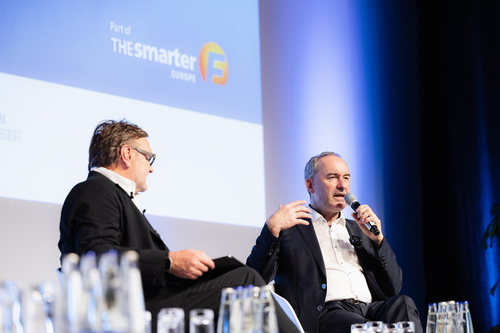
The Hydrogen Dialogue Summit took place for the first time at The smarter E Europe 2026. High-profile keynote speakers and panelists from the worlds of politics, the German Federal Network Agency, as well as representatives from industry, academia and associations, highlighted the opportunities and challenges of the hydrogen ramp-up. It became clear that the technological foundations are largely in place – now, regulation, investment and a strategic European industrial policy will be the key factors in determining whether the hydrogen ramp-up succeeds.
The ees Europe is Europe’s largest and most international exhibition for batteries and energy storage systems. Within the context of a renewable energy system, various storage technologies complement one another: while battery storage plays a central role, particularly in providing short- and medium-term flexibility and grid stability, hydrogen is regarded as a key component in the decarbonization of energy-intensive industries. The use of green hydrogen, for example in the cement and steel sectors, is currently gaining momentum. In the chemical industry, it is already in use today. At the same time, hydrogen is being discussed as a long-term storage solution for renewable energy.
Under the patronage of the Bavarian Minister of State for Economic Affairs, Regional Development and Energy, Hubert Aiwanger, the Hydrogen Dialogue Summit 2026 was launched as the leading conference on hydrogen, bringing together international decision-makers from industry, politics and the energy sector. The first day of the conference featured the session “System-Serving Electrolysis - From Grid Congestion to Storage Solutions”, which explored the prerequisites for a successful hydrogen ramp-up. Topics ranged from system-serving electrolysis and resilient infrastructure to investment-enabling framework conditions, while also addressing the need to strengthen European competitiveness and technological sovereignty.
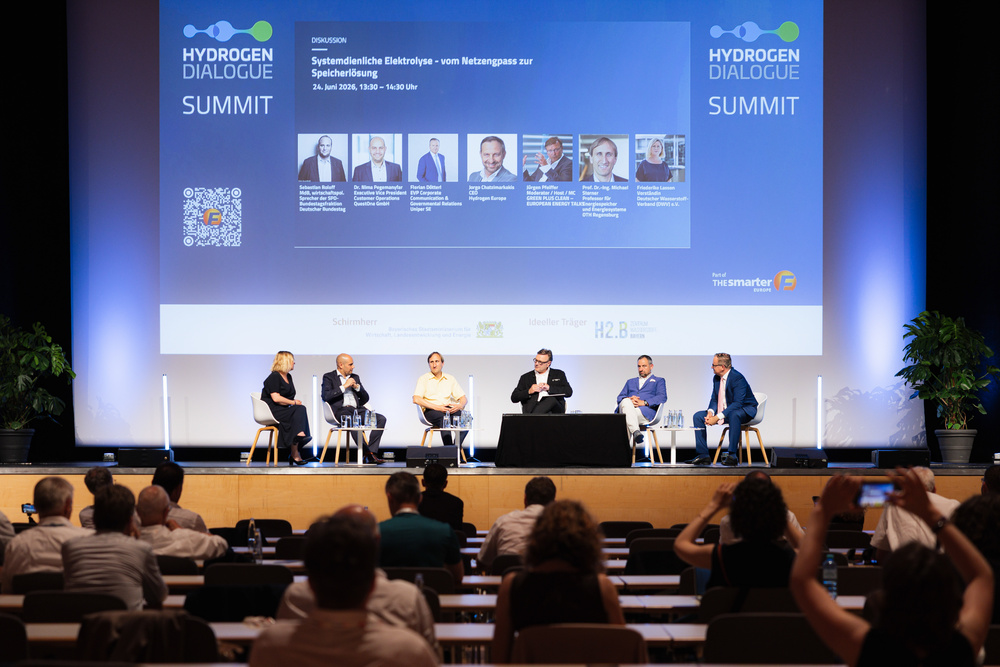
There was broad consensus among the panelists that hydrogen can only succeed as part of an integrated energy system. The ramp-up requires not only the expansion of electrolyzer capacity, but also the development of high-performance hydrogen networks, suitable storage infrastructure, as well as international supply chains and import strategies.
Emphasis was placed on the role of system-serving electrolysis. Given the high costs of grid congestion management – estimated at around 3.1 billion euros in 2025 (Bundesnetzagentur/SMARD) – electrolyzers can make an important contribution to grid stability by flexibly absorbing electricity from renewable sources and converting it into hydrogen. This helps to reduce grid congestion, make better use of renewable generation and, at the same time, create additional flexibility for the energy system.
Against this backdrop, hydrogen has been identified as a key component of energy transition and a sustainable industrial policy. Aiwanger emphasized: “We must make the most of the opportunities that hydrogen offers us.” The technology is regarded as essential, particularly for the decarbonization of energy-intensive industries and the long-term storage of renewable energy. Sebastian Roloff, member of the German Bundestag (Germany's federal parliament) and economic policy spokesperson for the SPD parliamentary group, explained that hydrogen must be used where no other climate-friendly alternatives are available.
The panel made clear that the necessary regulatory conditions and infrastructure frameworks must now be established to enable the entire system of production, transport, storage, and use to grow in an economically viable and reliable manner.
The structure of grid tariffs remains a decisive factor for the ramp-up of hydrogen. While existing special provisions for electrolyzers are considered under the current transitional arrangements, the Bundesnetzagentur (Germany's federal network agency) is developing a new framework designed to provide planning certainty while promoting system-serving behavior. The panel therefore emphasized that grid tariffs must not further hinder the already cost-intensive and currently limited market-driven hydrogen ramp-up.
Klaus Müller, President of the Bundesnetzagentur, explained in his video message that the Agency is working to create a framework that meets both national and European requirements. The aim is to finalize the matter by the end of 2026, thereby creating significantly greater planning certainty for market participants. In this context, he emphasized: “Hydrogen is a key contribution to the success of the energy transition.”
The continuing uncertainty surrounding the structure of grid tariffs is perceived within the industry as a barrier to investment and hinders the hydrogen offtake as a storage and flexibility solution. Investors are calling, above all, for long-term price and planning certainty. This applies not only to grid tariffs but also raises questions considering the still unclear framework conditions in the industry. Overall, this points to a structural demand problem that is currently holding back market-based ramp-up.
There has been some controversy over the type of hydrogen with which this ramp-up should begin. Blue hydrogen is produced from natural gas, whereby the resulting CO₂ is reduced through carbon capture and storage (CCS). Green hydrogen, on the other hand, is produced by the electrolysis of water using electricity from renewable energy sources and is regarded as a climate-neutral target option.
Florian Dötterl (EVP Corporate Communication & Governmental Relations, Uniper SE) argued in favor of permitting blue hydrogen as a bridging technology to accelerate the market ramp-up and reduce costs. Dr Nima Pegemanyfar (Executive Vice President Customer Operations, QuestOne GmbH), on the other hand, warned against presenting blue hydrogen merely as a transitional solution that would later be converted to green hydrogen. This could create uncertainty among investors and customers and thus delay investment.
The issue of CO₂ pricing was also raised: Aiwanger regarded it as a burden on the hydrogen economy. While Roloff also did not consider it ideal, he assessed its cost impact as relatively minor compared to other factors.
One key question emerged from the Hydrogen Dialogue Summit: How can Europe prevent a new economic dependency on electrolyzers, similar to those that have emerged in other sectors? The answer to this was partly evident between the lines and partly stated explicitly: Europe must strengthen its technological sovereignty.
“When taxpayers’ money is involved, European technologies should be used,” demanded Jorgo Chatzimarkakis (CEO of Hydrogen Europe). Friederike Lassen (Chairwoman of the German Hydrogen Association DWV) also advocated for “pushing” technologies in Germany and Europe rather than relying on others. Prof. Dr.-Ing. Michael Sterner (Professor of Energy Storage and Energy Systems, OTH Regensburg – Technical University of Applied Sciences), warned against a repeat of the dependencies seen with batteries and solar modules, and emphasized the need to establish a European value chain.
The panel discussion focused on concerns regarding Europe’s and Germany’s excessive dependence on Asia, particularly China. A key approach to addressing this challenge was the targeted promotion of hydrogen projects, electrolyzer technologies and European value chains. “Made in Europe” was highlighted as a strategic factor in terms of competitiveness and security.
At the same time, it became clear that hydrogen imports will be indispensable. However, these should not come from individual countries, but from various regions of the world, to avoid creating new one-sided dependencies. The development of a European hydrogen value chain remains a key objective, particularly with regard to potential strategic dependencies. The discussion centered less on whether imports are necessary and more on the extent of European self-sufficiency.