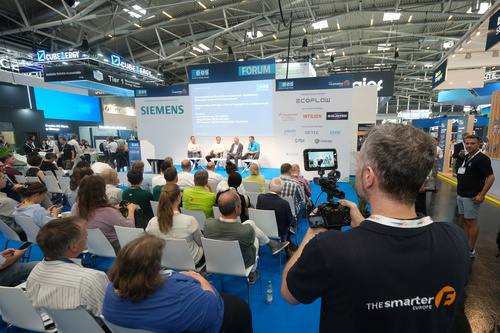
Battery storage is evolving from a supplementary component to a cornerstone of the energy system. At this year’s ees Forum on this topic, however, it became clear that grid connections, regulatory uncertainties, and the structure of the capacity market will determine how quickly expansion can proceed.
At ees Europe, there was broad agreement among panelists Franz-Josef Feilmeier (CEO, FENECON), Georg Gallmetzer (CEO, Eco Stor GmbH), and Thilo Engelmann (Head of Battery Storage at Trianel GmbH) that battery storage systems will play a key role in shaping the future energy system. The actual debate centered on the question of which framework conditions could accelerate or slow down the expansion. Engelmann emphasized: „We are still at the very beginning of scaling up battery storage for a climate-neutral energy economy.“ Gallmetzer pointed out that at this stage of market development, energy storage is needed in all areas of application for decarbonization. However, grid connection capacities are increasingly becoming a bottleneck.
Despite these bottlenecks, the companies see significant market opportunities. In the future, storage systems will play an important role not only in the integration of renewable energy but also in ensuring the flexibility of the entire energy system. While actual expansion is still lagging behind the long-term demand, the project pipeline is growing at a rapid pace. Feilmeier expected a particularly strong market ramp-up in the commercial and industrial (C&I) segment. AI-supported optimization of load profiles and electricity prices could enable payback periods of less than five years.
- Julian Jansen, Germany’s Managing Director at Fluence, on the rapidly growing market for grid-scale battery storage:
Ironically, the very technology intended to bring more flexibility to the power system is increasingly facing limits to its own expansion: Battery energy storage projects are attracting investors, but securing a suitable grid connection is often proving far more difficult. While the storage market is growing rapidly, available grid capacity is increasingly becoming the limiting factor.
The panelists identified this as one of the greatest challenges for further expansion. Storage projects are competing with industrial facilities and renewable generation projects for limited grid connection capacity. The crucial question is no longer whether there is sufficient interest in storage, but whether infrastructure, market rules, and processes can keep pace with the speed of development.
„We stormed into a party we weren’t invited to with tremendous force,“ said Gallmetzer, describing the rapid rise of battery storage. Engelmann also pointed out regional differences in the utilization of grid nodes: „Where large amounts of renewable generation are already connected, adding battery storage can be challenging. At other grid connection points, however, it is much easier.“
In addition to physical grid capacities, digitalization also became a focal point of the discussion. According to several panelists, regulatory processes and grid management tools have not kept pace with the dynamics of the storage market. Flexible grid connection agreements could help make more efficient use of existing capacities. However, this requires that such models remain economically attractive and offer investors sufficient planning certainty.
From the panelists’ perspective, key factors for the further expansion of battery storage comprise planning certainty and reliable regulation. While the industry benefits from improved framework conditions, such as exemptions from grid fees, short-term regulatory interventions continue to cause considerable uncertainty among investors.
Until now, battery storage systems have been exempt from double grid charges, avoiding network fees both when charging and when feeding electricity back into the grid. In early 2026, however, the Bundesnetzagentur (Germany's federal network agency) called this regulation into question as part of the reform of the „General Electricity Grid Fee System“ (AgNes). Particularly controversial was the agency’s statement that a changed interpretation of the legal framework could also affect existing investment expectations as well as projects that have already been planned but are not yet operational. From the industry’s perspective, this would weaken existing protections for investments and significantly undermine investment security.
Different perspectives emerged among the panelists. Engelmann criticized the approach from the federal network agency: „Announcements like this from the Bundesnetzagentur are causing consternation.“ In his view, the announcement amounted to a full stop for the industry. The potential damage would be considerable, particularly given the long development timelines for large-scale battery storage projects, which can extend to five years. He emphasized that double grid fees would have made storage projects economically unviable. The fact that more favorable framework conditions are now on the horizon is, he said, a result of the industry’s strong response.
Feilmeier, on the other hand, painted a largely positive picture of political developments to date: „We feel supported by policymakers. (...) A lot has happened in terms of economic viability, but the journey is not yet over.“ Policymakers are fundamentally pursuing the same goals as the business community, even if implementation is proceeding too slowly in his view. He cited the removal of bureaucratic hurdles, the growing acceptance of storage projects in permitting procedures, and exemptions from grid charges as key areas of progress. Storage systems can now be fully integrated into and marketed within the energy market. The next step, he said, is to complement the existing energy-only market with a capacity market.
The future role of battery storage is also becoming increasingly important on the political agenda. With its power plant strategy, the German government aims to ensure security of supply while renewable energy capacity continues to expand. The first step is to tender new dispatchable capacity. The focus is on plants that can provide electricity even during extended periods of low wind and solar generation. At present, this role is primarily expected to be fulfilled by flexible gas-fired power plants that can transition to hydrogen operation in the future. In the long term, a capacity market is planned that would also include other technologies such as battery storage and additional flexibility options.
Battery storage can balance out short- and medium-term fluctuations in the power system. Against this backdrop, the panelists discussed the future contribution of storage technologies to security of supply. Feilmeier saw greater potential for large-scale battery storage during periods of low renewable generation and raised the question of whether storage systems could provide a sufficient bridging solution. The other panelists, however, acknowledged that flexible power generation capacity may still be required during prolonged periods of low renewable output. Engelmann explained: „In other countries, scenarios show that battery storage is sufficient in most cases. However, gas-fired power plants are still needed as a safeguard.“