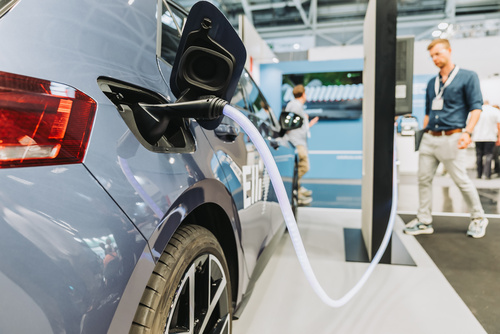
Companies and operators of commercial fleets face a logistical challenge as they transition to electric mobility. If dozens of company and rental vehicles are connected to wallboxes at the same time, there is a risk of exceeding the building’s maximum connection capacity.
The previous standard procedure – static load management, in which the total available power is simply divided equally among all active charging stations – is reaching its limits in practice. As a result, vehicles often charge more slowly than necessary, even when they urgently need to be ready for use.
To address this, the Federal Network Agency (BNetzA) has established the legal framework for controllable consumption devices through the new regulation in Section 14a of the Energy Economy Act (EnWG). To protect the grids while avoiding penalties for exceeding peak load limits, the integration of artificial intelligence into charging management (V1G) is gaining traction. Through the use of predictive algorithms, charging is evolving from a purely reactive power distribution process into a proactive system integrated into business processes. These AI-driven systems operate dynamically and process a wide range of external data sources to precisely optimize the charging process.
The commercial sector is one of the key drivers of electric mobility in Germany. According to official registration statistics from the Federal Motor Transport Authority (KBA), the majority of all annual new registrations of electric passenger cars consistently account for commercial owners. Optimizing charging processes in this segment therefore affects a market of significant economic importance.
Existing static systems, for example, rigidly limit each car to 11 kW when 10 vehicles are connected to a single 110-kW outlet. If the first vehicle is already fully charged, the allocated portion often remains blocked and unused. AI-based load management breaks this inflexibility. By continuously analyzing data streams, companies achieve tangible benefits:
The intelligent energy management system from the Aachen-based company gridX demonstrates how this interaction works in practice; with its IoT platform XENON, gridX equips, among others, DHL Express logistics sites.
At highly automated distribution centers, charging the electric delivery fleet must not jeopardize ongoing operations, such as the error-free, uninterrupted operation of the sorting systems. gridX’s software acts as an intelligent shield in this context: It continuously monitors the building’s current base load and the capacity at the grid connection point in real time.
As soon as the sorting machines start up or the general building load reaches peak levels, the algorithm automatically adjusts the charging behavior of the electric vehicles within seconds. The system calculates the optimal charging schedule so that the vehicles are ready to go right on time for the next delivery wave, without ever risking an overload. This completely eliminates the need for a physical, extremely expensive expansion of the local power grid.
Scientific studies confirm the economic benefits of these predictive algorithms. For mathematical optimization, the AI links three data streams: departure times from the logistics or booking system, the current state of charge via standardized vehicle telematics, and the generation forecast from any existing solar power system.
The results of the Fraunhofer analysis and real-world data show that pure energy costs in fleet operations are demonstrably reduced by approximately 10 to 15 percent. This effect is achieved solely through the targeted avoidance of costly grid capacity overages (peak shaving) and the automated utilization of surplus self-generated electricity.
The integration of AI systems into V1G smart charging demonstrates that software is increasingly replacing physical infrastructure. As companies face growing pressure to reduce both CO₂ emissions and operating costs, dynamic, data-driven load management is evolving from an innovation project into a standard tool in fleet and real estate management. Those who make intelligent use of data streams not only reduce their operating costs but also ensure their fleet’s operational readiness at all times in a more volatile energy market.
In addition to smart V1G, V2G (Vehicle-to-Grid), also known as bidirectional charging, is already in the starting blocks. The technology is ready for the market. While V1G merely shifts the timing of the power flow and throttles it, V2G transforms the stationary fleet into an energy storage system. AI algorithms play an even more central role here: They calculate when vehicles can not only draw power but also feed it back into the building’s or public grid – without compromising the range needed for the next trip or the battery’s lifespan.