Europe is diverse, both in terms of geography and in terms of culture. And the solutions for the energy transition in the various European countries are just as diverse. The smarter E Europe regards this diversity to be an opportunity to learn from each other and to make the energy transition happen even faster and more efficient in each of the countries.
This series of articles presents innovative and successful projects from across Europe that show how a renewable 24/7 energy supply can work. The case studies should provide impulses and inspiration, turning “does not work” into “already exists”.
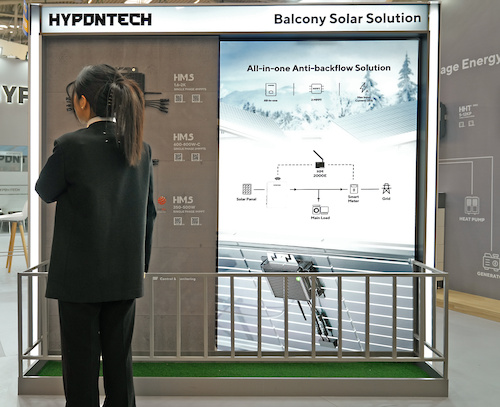
Our balconies are the epicenter of a solar revolution. According to the German Solar Association (BSW-Solar), one million registered plug-in solar devices were already connected in Germany by June 2025. These mini solar installations are capable of outputs of up to 2,000 watts in Germany. They can be installed on balconies (as is the case for around one third of all plug-in solar devices), but also on building façades, in gardens or on flat roofs. Users can set up these systems themselves by plugging them into a domestic socket with a Schuko plug. This means both tenants and property owners can be part of the energy transition at a low-threshold. The purchase usually pays off after a few years.
The energy transition is a project firmly driven by the population. Plug-in solar devices offer a “Solar-To-Go” solution for everyone, not just for homeowners who have their own roofs. They are simple and affordable, meaning they have become a mass-produced item in Germany and are, in turn, boosting acceptance of the energy transition among the population. Consumers set up their own mini solar installations, usually comprising one or two solar panels, in their homes and use an app to track solar power yield. This gives them a deeper understanding of how a renewable energy supply works. At the same time, plug-in solar devices foster enthusiasm about the chance for people to independently produce their own electricity. Plug-in solar in Germany has also been a success from an financial perspective, because low initial investment allows a broad section of the population to access their own solar installation. After all, people are very interested when it comes to saving electricity costs. The widespread use of plug-in solar devices makes decentralized energy possible even in urban areas.
According to a study by the European industry association SolarPower Europe, in Berlin, a plug-in solar device with a production capacity of 900 kilowatt hours and a suboptimal orientation meets 8 to 13 percent of the annual electricity demand of a one- to two-person household, with a self-consumption rate of 99 percent. To compare, systems in Madrid meet 10 to 20 percent of the demand. In most cases, the produced electricity feeds stand-by devices such as WiFi routers or refrigerators.
In 2024, two in five installed PV systems in Germany were plug-in solar devices. A study by HTW Berlin estimates that, if you include unregistered devices, there are already between 1.5 and 4 million plug-in solar devices connected in Germany. According to estimations from Bundesverband Steckersolar, the German association for plug-in solar, the number of plug-in solar installations across Europe is between 4 and 5 million. Even though many European countries have already paved the way for plug-in solar through legislation, these markets remain small, and separate market data for this segment is often lacking. In France, according to French distribution system operator ENEDIS, a total of 34 megawatts of cumulative capacity from installations with up to one kilowatt was connected at the end of 2024. In Austria, there are around 20,000 systems with a capacity of 10 to 15 MW, according to the regulator E-Control. The European Union is encouraging member states to subsidize plug-in solar devices under national legislation via the New Electricity Directive for Electricity Market Design. According to SolarPower Europe’s study, markets in France, Spain, Poland, the Netherlands and Italy are expected to ramp up.
Residential storage systems combined with plug-in solar devices are also becoming increasingly popular, but is this combination really worth it? One of the Intersolar Forum sessions during Intersolar Europe 2025 explored this topic – go to our on-demand platform The smarter E Digital.
You were unable to attend the event or missed a session? No problem! Most of the presentations are available for you on The smarter E Digital.
30 Minutes to Process a Feed-in Connection Application
Zero Bills Home: Living Without Power And Heating Costs