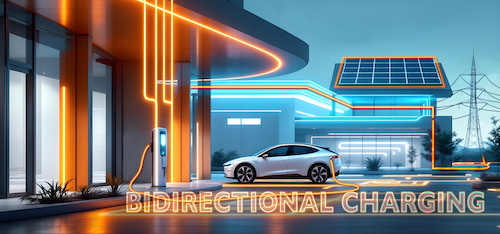
Bidirectional charging is no longer just a concept – it’s already working in real markets. In the make-ready tot he Special Exhibit Bidirectional Charging at the Power2Drive 2025 Marcus Fendt from The Mobility House shares insights on V2G, the latest innovations, and where the technology is heading next in an interview with Carla Westerheide from electrive.
AC or DC? From a music point of view, both! (lacht)
I can’t tell you what is winning in detail, but I believe both will exist for certain applications. However, from a pure technical standpoint, AC should be better in the long run. And by long run, I mean five years plus. The reason is that AC can drive costs down further for customers, which is a key factor for the success of this technology. But it won't be the best solution for every use case.
The key innovation is that we are live! You’ve reported on this before.
We are live with V2G - With a series car, with a series product, with an energy tariff available to the customer. After 15 years of work—where our team relentlessly programmed, discussed, and coordinated with all stakeholders—it’s finally working! Unfortunately, it's only in France at the moment. That’s great from a proof-of-concept perspective, but I would have preferred if Germany was moving at the same speed. Right now, we're about one and a half years behind.
The key takeaway here is: It works!
What are the key elements? The car is on the market, it has an AC charger, and we have access to it. Customers can use a smooth app to set preferences, and we can aggregate these vehicles to participate in energy markets. As a result, customers in France receive 10 cents per plugged-in hour. This system works almost perfectly on the customer side. We still have some technical issues in the background, which we need to resolve before scaling to more car manufacturers, more countries, and more use cases. Once that’s done, we can start mass rollout.
But V2G isn’t the only approach. We also have V1G, which every EV can already do. We see growing interest from fleets in particular because they consume a lot of energy. For example, a single bus in a depot consumes around 100 megawatt-hours per year. Once they address their initial charging challenges, fleet operators quickly start thinking about their energy bills—because that’s an operational cost they can reduce. We’re now seeing private customers in Germany tapping into this as well, thanks to regulations like Paragraph 14, which offers grid fee reductions. With smart charging (V1G), they can already save around €400 per year just by charging when the sun is shining or when the grid is not overloaded. This is becoming a standard product.
Both V1G and V2G will continue evolving in more countries and with more players.
There are two key conditions that must be met for V2G to work:
These requirements limit the number of potential markets.
Our next step is the UK, later this year. Germany is not fully deregulated yet, so hopefully next year. In the US, Texas will be a viable market. California could work with some exemptions. We’re also looking at Japan, where they recently introduced an exemption for V2G beyond just backup power.
Smaller markets in terms of EV volume like the Netherlands, Benelux in general, Denmark, Norway, and Sweden are also on our radar. However, in Sweden, the need for flexibility is lower because they rely on hydropower, which already provides sufficient energy storage. The potential for the customer is limited.
That’s a very global outlook! What are the broader global trends you see in bidirectional charging and energy infrastructure?
Good question! One of the most significant global trends is what’s happening in China.
I was surprised to see reports—possibly even from Electrive—suggesting that China has already reached "peak oil." For the first time, their oil consumption decreased compared to previous years. While the economic slowdown played a role, the bigger factor is that 50% of new car registrations are already electric. And buses and trucks are following.
This means they need far less oil than before. At the same time, China is expanding renewables massively - solar, wind, and stationary storage. The leading trend globally is cheap energy production combined with storage for flexibility. And the cheapest storage option is EV batteries, simply because cars are parked 23 hours a day. In Germany, the average daily driving distance is 36 km, which requires about 8 kWh of energy. For more efficient EVs, it’s even less.
So, the global trends are clear: more renewables → more flexibility in the system → more energy storage → which can be provided by stationary batteries or by a car. This transition is now unstoppable because the economics of renewables are just too compelling. So even “drill, baby, drill” will not stop except you force people to buy the cheaper solution. Therefore the obvious trends will be renewables and then providing flexibility services out of EV batteries. So, will there be competition between stationary storage and EV batteries? Yes—but not for at least the next 10 years.
Right now, the focus is on learning from stationary battery storage. Limited to a certain extent because you don’t have that much grid connection. And then you have EVs coming and you learned already how powerful und useful batteries are. EVs profit from it and so are the EV drivers. It’s a natural handshake.
As an entrepreneur, I can’t afford a crystal ball! (lacht)
But what I can say is: By early next year, we’ll have two additional OEMs launching bidirectional-capable vehicles. Discussions are ongoing with two or three more for the following years. So, from 2026 onwards, nearly every new EV will be bidirectional-capable.
Now, it’s on us to be the leading provider. We have the necessary technology stack in place—both for being the aggregation platform which enables you grasp the value for the costumer and connect energy markets and the different vehicles and on the other side that trading or offering energy tariffs can be handled by ourselves or by others. We connect these two worlds. I’m incredibly proud of our team for getting us to this point. We are now in full delivery mode. Of course, not everything is perfect yet, but we improve every day.
Of course!