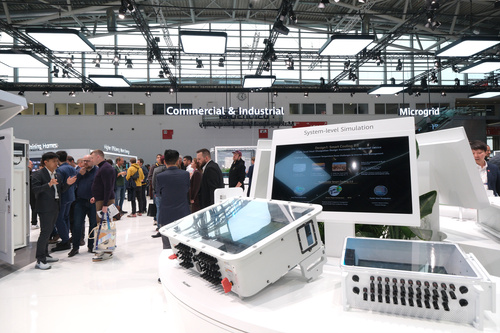
Rooftop photovoltaics (PV) remains a cornerstone of Europe’s energy transition, with the commercial and industrial (C&I) segment currently seeing the strongest growth. While the residential segment is contracting as funding cuts take effect, combined solutions that boost self-consumption are gaining importance in the C&I segment. This trend was also evident at Intersolar Europe 2026 and its accompanying program.
The market is benefiting from favorable conditions: More and more commercial and industrial companies are looking to shield themselves from rising electricity and fossil fuel prices, while also meeting sustainability requirements and increasingly stringent EU-wide mandates for solar installations on commercial buildings.
At the same time, the rapid decline in battery storage system prices and the growing popularity of EV fleets are driving interest in integrated solutions that combine PV with these complementary technologies. As a result, the C&I segment experienced a boom at Intersolar Europe 2026. This was evident not only at the product-level, with many of The smarter E Europe’s 2,650 exhibitors showcasing products such as inverters and all-in-one solutions for C&I, but also in the event’s accompanying program. Several sessions took a deep dive into the topic, including the Intersolar Forum’s session titled PV-Plus-Storage with Fleet Management for Industry and Commerce – a Smart Combination, and another titled DGS Forum Solar Installations in Industry and Commerce. The special exhibit Renewables 24/7 also put a particular focus on the sector with its Commerce thematic area.
In the rooftop segment, the focus is clearly shifting toward commercial and industrial applications. According to Enedis/RTE, approximately 65 percent of newly connected capacity in France is already in the 100- to 500-kilowatt-peak (kWp) range. The cost-effectiveness of self-consumption is a key driver: According to Fraunhofer ISE, companies in Germany can generate solar power from their own rooftops at a cost of 5.6 to 12 euro cents per kilowatt hour (kWh), compared with 14 to 16 euro cents per kWh for electricity supplied from the grid. At the same time, the value of feeding electricity into the grid is declining. In countries such as France, Germany, Spain and Poland, negative electricity prices occurred more frequently in the first half of 2026 than throughout all of 2025, according to LevelTen Energy. This makes every self-consumed kilowatt-hour more valuable. Complementary technologies can help further unlock the full potential of PV systems: Battery storage systems, heat pumps and charging infrastructure for e-fleets allow solar power to be shifted to where and when it is needed most. These combinations are driving the C&I boom. According to EUPD Research, C&I storage installations across Europe are expected to grow by 78 percent in 2026, while 59 percent of specialist companies already offer charging infrastructure.
The C&I market is also gaining momentum beyond France. According to the Spanish solar energy association UNEF, industrial self-consumption was the only segment to grow in Spain in 2025, reaching 679 megawatts (MW). In Romania, the C&I segment has already reached a cumulative capacity of 1.8 gigawatts (GW). According to EUPD Research, Italy, the UK and the Netherlands are currently sending the strongest signals for further C&I growth.
One highlight of the Intersolar Europe 2026 accompanying program was the special exhibit Renewables 24/7. It vividly demonstrated how fully renewable power generation combined with energy storage (battery storage, green hydrogen), the electrification of transportation and heating (heat pumps, electric boilers), and intelligent energy management (peak shaving, bidirectional charging, etc.) can provide a cost-effective, low-emission and reliable energy supply for commerce and industry. The special exhibit also showcased pioneering projects from partner companies that are already putting these solutions into practice, and generating profits today.
Special Exhibit Renewables 24/7
A project by encentive GmbH at cold chain logistics company Peter Bade GmbH in Neumünster, Germany, demonstrates just how much potential there is in existing infrastructure. The initial situation was a common problem: The company lacked an overview of its own energy flows, while self-generated PV electricity and favorable spot market prices went unused and peak loads drove grid costs. Since 2022, an AI-powered platform has been integrating and controlling the cooling system, heat pump and PV systems at the 6,500-square-meter cold storage warehouse, taking into account weather, consumption, and price forecasts. The results in the year under review are impressive: an 11.3 percent decrease in electricity consumption, a 15.6 percent decrease in energy charges, a 30 percent decrease in grid charges and 54 metric tons of carbon emissions saved. The project demonstrates the special exhibit’s key message in practice: A major lever for decarbonizing commerce and industry lies in the smart control and integration of existing systems.
In collaboration with Fenecon and Timeless Planet, the Bad Wörishofen thermal spa proved that this principle can also be applied to facilities with a high continuous demand. Modern spa facilities rank among the highest energy and heat consumers in the service sector – which is why the goal was to establish a long-term, cost-effective and crisis-resistant supply that generates as much electricity on-site as possible while reducing grid consumption. At the heart of the modernization is a 1.34-MW PV system serving as a large parking lot canopy, supplemented by 28 EV chargers and large-scale storage systems with a total capacity of 3,864 kWh. This integrated system turns the thermal spa from a traditional consumer into an intelligently controlled smart grid player that can generate up to 180 percent of its own demand on sunny days and, at times, operate completely self-sufficiently. The self-consumption rate increases, grid consumption drops dramatically and costs become predictable in the long term. The project is considered a European blueprint for the tourism and service sectors.
Intersolar Europe 2026 demonstrated just how central the C&I sector has become to Europe’s solar industry. Driven by the profitability of self-consumption, falling storage prices and growing regulatory requirements, commercial and industrial companies are no longer looking solely for a PV system, but rather for an integrated, holistic system comprising generation, storage, heating, e-mobility and intelligent control. The pioneering projects featured in the Renewables 24/7 special exhibit demonstrate that such solutions are already economically viable today, and that the greatest potential often lies in the smart integration of existing systems. For the industry, this means that those seeking to tap into the C&I market will, in the future, offer fewer individual components and instead focus on integrated, cross-sector energy concepts.