Electrification is no longer just about roads – it has evolved into a far-reaching, cross-industry transformation process. While public perception is often dominated by passenger car ranges and charging stations along highways, a technological and logistical transformation is taking place off the beaten path. Whether on water, in the air, or in rough terrain: A wide variety of industries are switching to electric propulsion, thereby fundamentally redefining their operations.
The maritime sector is among the pioneers of far-reaching decarbonization. Norway provides an outstanding example of best practice in this regard: With groundbreaking projects such as the world’s first fully electric car ferry, the MF Ampere, and nearly 90 electric ferries now in regular service, the Scandinavian country is demonstrating how the transition can be achieved. This is made possible by modern battery storage systems and new, standardized megawatt charging systems at ports that keep charging times short. Smaller, all-electric inland container vessels in regions such as Scandinavia and the Benelux countries are also increasingly operating autonomously to optimize shuttle service between major ports and the countryside. The recent launch in China of the world’s largest all-electric container ship further underscores this trend toward electrification. The “Ning Yuan Dian Kun” recently began commercial operations. It is 127.8 meters long and 21.6 meters wide, with a capacity of approximately 9,600 metric tons.
At the same time, developments are also taking place in the aviation sector. The market for electric vertical takeoff and landing (eVTOL) vehicles is growing. Companies such as EHang are driving the certification process forward with manned test flights and international initiatives. Electrically powered small aircraft for regional transport, with 9 to 19 seats, are also making significant progress toward certification, with the goal of making feeder traffic between airports local and emission-free. However, since the energy content per unit weight of conventional lithium-ion battery cells imposes physical limits, manufacturers are primarily relying on the development of solid-state batteries or hybrid interim solutions with high gravimetric energy density to achieve greater ranges.
The working environments on our construction sites are changing just as rapidly. Electric mini-excavators, wheel loaders, and track loaders have long been an integral part of the product portfolios of industry giants such as Bobcat, Volvo, and Caterpillar. They really come into their own, especially in urban and inner-city projects: In addition to being locally emission-free, they offer drastically reduced noise and vibration levels. This not only noticeably improves working conditions on the construction site but also allows for extended operating times in sensitive residential areas. Thanks to the availability of on-site power and the local work location, permanent battery operation isn’t even necessary in some cases – machines can operate while plugged in.
To support this, the federal government in Germany is driving this transition forward with targeted subsidy programs. Grants and low-interest KfW loans with repayment subsidies help offset the high initial purchase costs. Combined with significantly lower maintenance and energy costs, this means that the zero-emission machines pay for themselves much faster. Another approach involves clearly favoring electric vehicles or factoring CO2 emissions into public tenders.
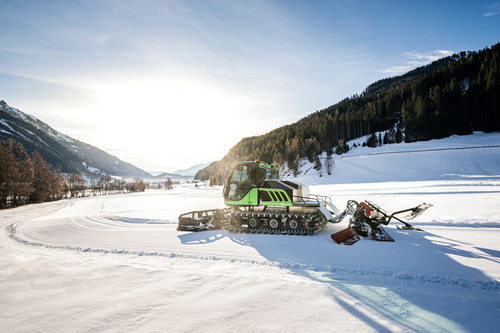
Electrification doesn’t stop at the ski slopes. This is demonstrated by the recently announced partnership between the drivetrain specialist Scania and the snow groomer manufacturer Prinoth. Through this long-term collaboration, the heavy-duty specialty vehicles are to be equipped with robust battery systems. The Husky E-Motion model was already electric, and the Leitwolf E-Motion is now set to follow. This will make ski operations in sensitive high-mountain regions locally emission-free and quieter in the future. Additionally, the snow groomers can be charged during the day, allowing operators to benefit from cost-effective solar power. Snow groomers thus serve as an excellent example of how even energy-intensive niche applications can be successfully electrified.
The fact that extreme loads under harsh conditions can be handled economically using electric power is also evident in open-pit mining. The Swedish open-pit mining company LKAB relies on fully electric 120-metric-ton heavy-duty trucks from Scania for its underground operations to transport iron ore locally with zero emissions.
While urban construction machinery has long been an economic reality thanks to falling costs and government subsidies – and the maritime industry and specialized sectors are gradually following suit – electrification in aviation remains a marathon with a long-term horizon. Across all industries, the pace of this transformation will depend on how quickly battery and infrastructure innovations can overcome the respective physical and economic hurdles.
